Home > Newsletters > Exploring Ongoing Coaching and Support for Triple P
Exploring Ongoing Coaching and Support for Triple P
In this issue:
- A note of gratitude and transition
- Recap of the May 22nd Child Welfare Learning Collaborative session: Ongoing Triple P Supports
- Strengthening families through collaboration: NC Triple P & Local DSS agencies
A Note of Gratitude and Transition
This publication marks the final issue of the Triple P Brief. Although funding for Triple P implementation support for child welfare agencies has come to a close, we remain committed to supporting North Carolina’s child welfare staff and agencies.
In this issue, you’ll find information about continued supports, resources that remain available, and ways to stay connected with Lead Implementing Agencies (LIAs) as we all work toward the shared goal of strengthening families and communities. We welcome you to frequent the Child Welfare Resource Page to locate tools, archived Triple P Briefs, and Child Welfare Learning Collaborative session recordings to support your Triple P implementation. You can also find numerous tools and resources on our ICTP website to support Triple P implementation.
Thank you for your partnership, dedication, and the important work you do every day.
May 22nd Child Welfare Learning Collaborative: Ongoing Triple P Support
The CWLC held on May 22nd highlighted the ongoing coaching and support that will continue to be made available to child welfare agencies as they explore and engage in Triple P implementation within their agencies.
As funding for Triple P implementation support ends, the NC Triple P Child Welfare Coordinator, Tamara Robertson, will no longer provide direct support to child welfare agencies after June 30, 2025. We remain committed to supporting North Carolina’s child welfare staff and agencies and encourage child welfare workers to explore other opportunities such as:
- Triple P Coaching
- Training
- Peer to Peer Support
- PASS Session
- Practitioner Conferences (offered in specific regions)
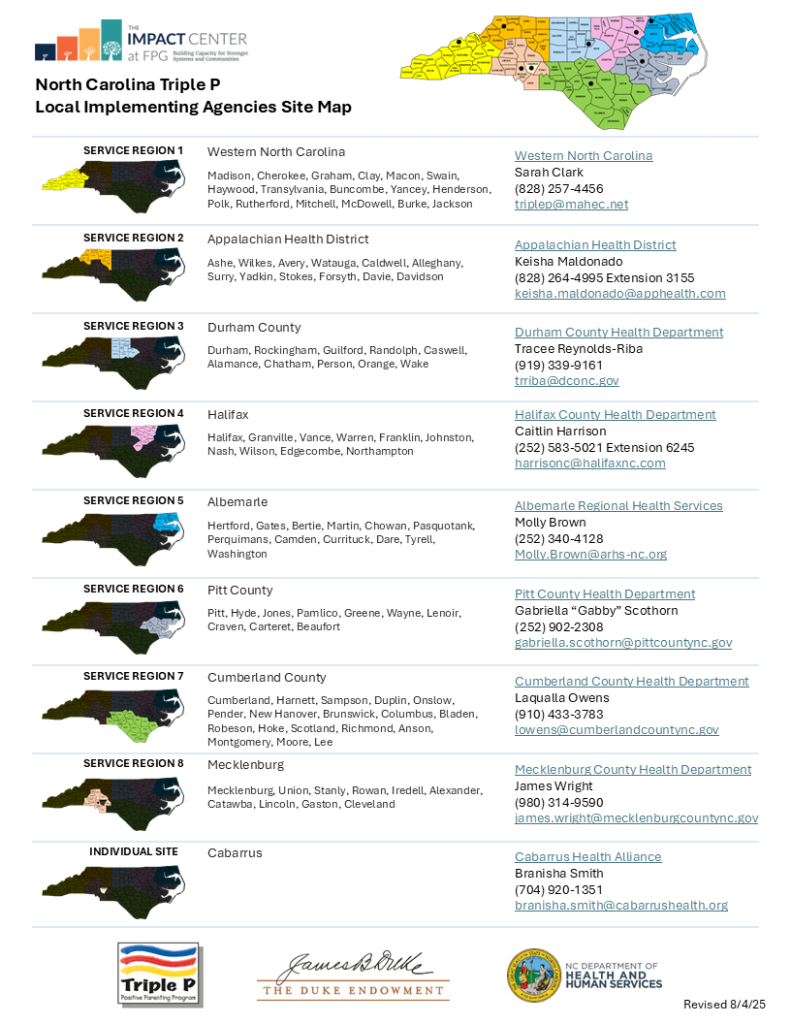
In addition, please feel free to contact your regional Triple P LIA listed below for Triple P questions or support.
Explore all Child Welfare Learning Collaborative Recordings and Materials.
Strengthening Families Through Collaboration: NC Triple P & Local DSS Agencies
North Carolina’s families thrive when family-serving community partners work together, and strong collaboration is at the heart of that success. Local Departments of Social Services (DSS) can play a powerful role in preventing crises and promoting long-term well-being by partnering with Lead Implementing Agencies (LIAs) to bring the Positive Parenting Program into everyday practice. By aligning Triple P’s proven strategies with your existing day-to-day work, DSS teams can provide parents and caregivers with the tools they need to thrive and make a lasting difference in their communities.
Why Local DSS Agencies Should Partner with Lead Implementing Agencies
Local DSS agencies are uniquely positioned to reach families at critical moments such as CPS involvement, reunification efforts, or economic hardship. By integrating Triple P into DSS systems, counties can:
- Prevent deeper system involvement through early intervention
- Improve parenting outcomes during foster care or reunification
- Support Work First families and kinship caregivers
- Offer caseworkers practical tools for supporting families
- Demonstrate progress toward Families First Prevention Services Act (FFPSA) and prevention-focused goals
Regional Lead Implementing Agencies: Your Triple P Support Team
Effectively implementing Triple P requires more than training; it requires infrastructure and guidance. That’s where Regional Lead Implementing Agencies (LIAs) come in. These agencies provide:
- Readiness and fit & feasibility assessments for your agency to determine which levels of Triple P best meet the needs of your clients
- Training and accreditation of child DSS staff and community providers
- Ongoing coaching (including peer support, data support, and fidelity support) to ensure Triple P is delivered effectively
- Data collection and outcome monitoring to show impact and guide improvement
- Cross-sector coordination across health, education, and human services
By partnering with your local LIA, your DSS team gains a knowledgeable partner invested in your success as well as brokering relationships with other parenting support programs, such as Improving Community Outcomes for Maternal and Child Health (ICO4MCH) (Currently in Guilford County, Mecklenburg County, Sandhills Collaborative, and Wake County).
Are You Ready to Explore Partnership? Contact Your Regional Triple P Support Team!
If your DSS team is ready to explore how Triple P can support your prevention, reunification, or family services goals, reach out to your regional LIA or contact a coordinator who is ready and excited to support you!
Did you know?
Triple P programs support parents of children from 0 to 16 years old through a range of different programs:
- Triple P is delivered to parents of children up to 12 years’ old
- Teen Triple P is delivered to parents of 12 to 16 year old
- Triple P for Baby helps you prepare for and adjust to parenting a newborn or infant
- Stepping Stones is a program for parents of children with a disability
- Family Transitions is a program for parents going through separation or divorce
- Lifestyle is a program for parents of children who are overweight
- Fear-Less Triple P is a program to help parents manage their child’s anxiety and develop emotional resilience
Triple P in a Nutshell
Learn more about Triple P
For more information, visit Triple P or use our
North Carolina Triple P Lead Implementing Agencies Site Map
to find and contact your Regional LIA coordinators.

Thank you to our contributors, funders, and partners
Triple P Brief Newsletters are developed by the Impact Center at FPG.
Contributors:
Author: Tamara Robertson, The Impact Center at FPG, UNC Chapel Hill
Design: Sonya Abbate, The Impact Center at FPG, UNC Chapel Hill
Funder:
NC Department of Health and Human Services
Connect with us!
And follow us on social media (links at the bottom of this page).