Home > Newsletters > Building Community Coalitions
Building Community Coalitions
A community coalition is a group of individuals, agencies, or organizations that agree to work together toward a common goal. Coalitions consist of co-creation partners and community champions.
Why use a coalition?
Groups might use a coalition to launch a community-wide initiative, enable more effective and efficient delivery of programs, eliminate the duplication of services, and create long-term, permanent social change.
Coalitions bring together people who work together collectively to:
- Share power and decision making
- Provide diverse perspectives and input
- Share learnings and resources
- Contribute more hands to do the work
- Plan for sustainability of the work
Coalitions are an essential component to successful program implementation and scale-up because they create local-buy in and maximize local assets to tailor the work to the local context and move the work forward.
What forms can coalitions take?
A coalition can take many forms and often evolves over time depending on its needs. The group’s design should relate to its primary purpose. Coalitions can be one or a combination of the following:
- Advisory Boards
- Leadership Teams
- Cross-system Teams
- Learning collaboratives
- Collaborative Innovation and Improvement Networks (CoIINs)
- Learning networks
- Community of Practice or practice groups (CoPs)
- Focus groups and interviews
- Town halls and forums
- Community leadership boards
- Parent and caregiver advisory boards and groups
Regardless of its form, strong communication, response, and feedback loops are common elements to successful coalitions.
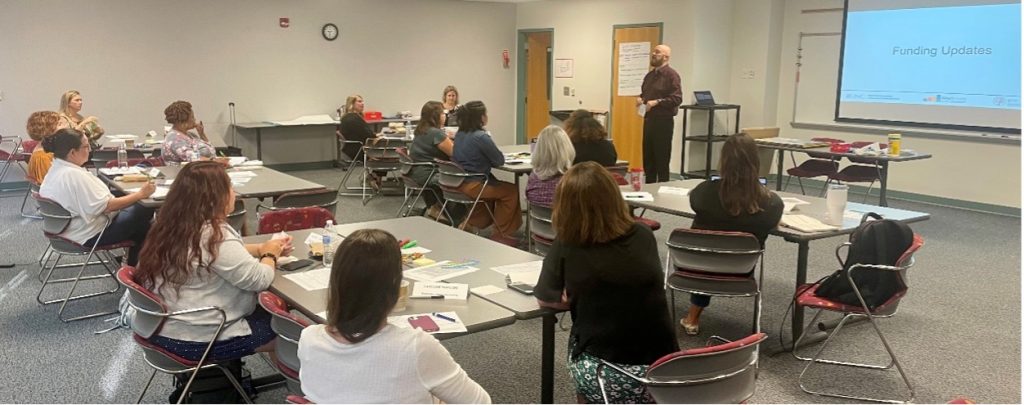
Pictured: Wake County’s Triple P coalition uses a cross-system coalition model
Steps to Building a Coalition
Forming a Coalition
When starting a coalition, it’s important to understand that issues are often complex and require multiple partners and strategies. When inviting partners, you may wish to:
- Ensure you have people in your coalition who you consider catalysts. Include passionate, influential champions as well as individuals who can use their influence to ensure change efforts are supported and sustained.
- Ensure your coalition is representative of your community and your coalition priority. For example, if you are trying to address child and family well being, it’s important to have representation from organizations who serve children and families and the families being served. Similarly, if you have a lot of Spanish-speaking families in your community, it would be important to have their representation in your coalition.
Initial Coalition Forming Steps
- Define your community issue.
- Identify an initial core group of leaders, champions, and other community partners that can support and inform your community change effort. It’s okay to start with people you know or who are closest to the issue.
- Create messaging to invite partners to your coalition efforts.
- Plan and hold your first meeting to begin to map your community issue with initial coalition members.
- Identify additional data and voices needed to develop your coalition’s working roadmap.
From the Field – Who’s Involved in Your Coalition?
Wake County Triple P Team
“The Triple P Wake Coalition is comprised of a wide variety of community partners who all support caregivers with young children. The Coalition includes speech, occupational, and play therapy practices, mental health and family support agencies, early childhood centers, Wake social services and public health, a large-scale family medical practice, and a children’s museum with the school system serving as backbone support for coordination of implementation.”
Halifax County Triple P Team
“We currently have trained Triple P practitioners and people who are in agency leadership positions as a part of our coalition. We would like to have more community partners involved and more agency directors or health directors who have the ability to control funding and allocate resources. We also think it could be helpful to have a parent representative – a parent who has participated in a Triple P intervention and would be able to provide feedback on implementation.”
Developing a plan for leadership is important for forming and maintaining your coalition. Leadership is the backbone of the coalition and ensures the group is working toward its shared purpose.
It’s important when forming a coalition that members understand and agree with each other about how the group plans to work together. To facilitate this agreement, your coalition can develop a Terms of Reference or Charter that outlines the purpose, goals, member expectations, and communication protocols for the group. Communication protocols and strategies are also helpful tools. A Terms of Reference can also be helpful for a coalition to develop a shared plan that guides the work of the coalition and outlines the goals and objectives and how they plan to work together to achieve those goals.
From the Field – Challenges in Forming or Leading a Coalition
“One of the challenges we face is that it is still a fairly new coalition. We have established a terms of reference for the team, but sometimes we feel like we are still learning exactly what the need and purpose of the team is and trying to navigate that in the most efficient way.”
Halifax County Triple P Team
Many times, community goals or priorities are already set by community health surveys or other community needs assessments. Using data from these assessments can help your coalition better understand the needs of the community without having to do a lot of data collection to help to prioritize collective efforts. Once priorities are identified, a coalition should consider including input from other champions and partners to co-create the plan.
From the Field – How are Coalitions Informing the Work?
“Our coalition has been able to provide us input on strategic planning, specifically when we completed our 5-year strategic plan. They also provide us feedback when we create new processes, like new data submission tools and our quarterly newsletters. We really look to them for feedback and input on how we can make improvements for the implementation of Triple P since they are the people ultimately doing the work in their agencies to provide Triple P.”
Halifax County Triple P Team
Active Coalitions
Once your community coalition has formed and a shared plan has been developed, the coalition is in a place to keep the momentum going and ensure the community is working collaboratively and cohesively. Activities may include:
- Shared learning and problem solving
- Shared training or professional development
- Shared resources and funding
It’s important to regularly revisit the purpose, goals and commitments of the coalition. This ensures that the coalition continues to meet the needs of the community.
From the Field – Lessons Learned
“It’s paramount that you intentionally make time for quality and purposeful relationship-building both individually with your agencies/contacts and as a group. This will enable you to more easily co-create a shared vision and processes that lead to a more successful implementation that everyone can support.”
Halifax County Triple P Team
Some coalitions use integrated data systems or shared data measures for learning and improvement. Organizations in the coalition agree to share their data with the coalition and use the data to identify areas for improvement and monitor trends and improvement.
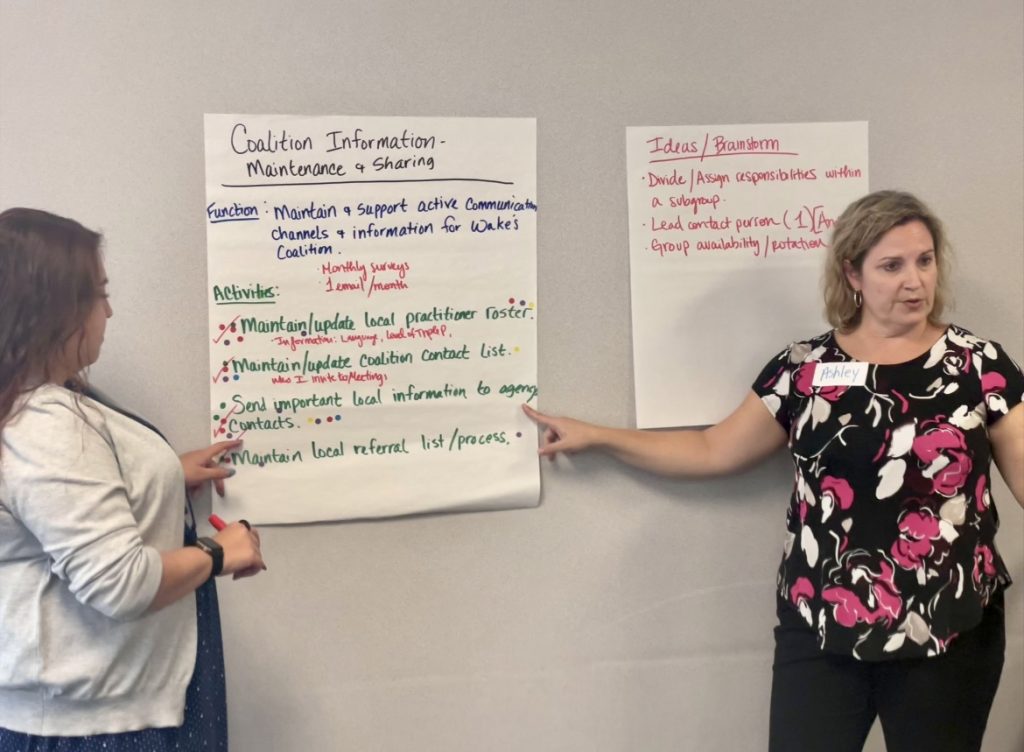
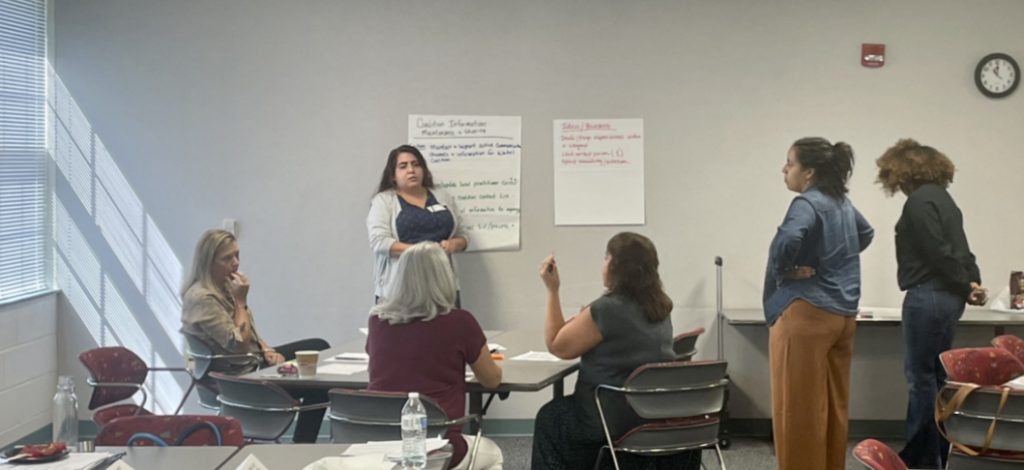
Pictured: Wake County Triple P Coalition, Raleigh NC
Maintaining a Coalition
A key consideration in building a coalition is how to keep it going over time. It’s important for coalition members to plan for maintaining the coalition to ensure the work is sustained. This requires understanding the planning, resources, influence, and capacities that are needed to keep the coalition running. It also requires sustaining engagement of members or organizations over time and making adjustments to meet the needs of the community and its members. Key strategies for maintaining coalition engagement and effectiveness are:
- Co-create a clear vision and working norms to create shared ownership and accountability. Reference the vision and working norms regularly.
- Ensure communication within the coalition and members is occurring frequently and effectively.
- Attend to creating an inclusive, participatory environment.
- Acknowledge the value of diversity among your members and their ideas and beliefs.
- Facilitate approaches that support collaboration. Consider co-creating agendas and activities with coalition members and share facilitation roles.
- Celebrate successes as frequently as you discuss challenges.
- Assess the health of your coalition periodically.
From the Field – Challenges in Maintaining a Coalition
“Initially, everyone’s partnership and level of commitment (MOU/MOA) was the same. As the work evolved, we learned that agencies may support the work in different ways. For example, an agency may have planned to provide direct Triple P services, but due to transitions, changes in leadership, etc. they may support the work more as a community champion and referral source. We had to learn to be flexible with what coalition partner involvement looked like and celebrate the unique ways each agency was able to support the work.”
Wake County Triple P Team
“For maintaining our coalitions, staff turnover as a LIA team and turnover in the agencies has been a challenge. Another challenge has been using zoom and meeting in a virtual setting. We know zoom meetings can be convenient for the members of the team, but it does limit the opportunity for that personal connection that you have with in-person meetings and we feel that members may not be as vocal in the virtual setting. We have tried to overcome this by establishing agendas with a set topic to guide the discussion. Also, having support from the Impact Center has helped us overcome some of these challenges. They help us direct our goals around our coalition and provide suggestions on improvements we can make.”
Halifax County Triple P Team
Tool Box-Featured Resources
- Forming Coalitions tool: Team Functions, Considerations and Core Competencies
- Maintaining a Coalition tool: Wilder Collaboration Factors Inventory
- Sustaining Coalitions tools: Program Sustainability Assessment Tool or Project Launch Sustainability Guide and Self-Assessment Tool
Additional Resources
- Empower Action Model – Children’s Trust of South Carolina
- South Carolina Children’s Trust – Building Coalitions
- Community Toolbox
- ICTP Learning Module – Coalitions
- Complexity Pathways Activity
Contributors
The Impact Center at Frank Porter Graham Child Development Institute, UNC-CH
Sherra Lawrence, Capri McDonald, and Christina DiSalvo
Wake County Triple P Team
Ashley Lindsay
Halifax County Triple P Team
Elane Edwards
Ashley Bowen
Amyieshia Joyner
For Triple P Support
For Triple P Service Delivery Agencies in North Carolina and South Carolina:
Connect with your regional Triple P Lead Implementing Agency or county Backbone Organization.
For Triple P Lead Implementing Agencies in North Carolina:
Contact your implementation support team with The Impact Center at FPG.
For Triple P Backbone Organizations in South Carolina:
Contact your community capacity coach with Children’s Trust.
Have questions about implementing your Triple P program? Please connect with us!