Home > Newsletters > Improving Triple P Services and Outcomes: Honoring Family & Community Voices
Improving Triple P Services and Outcomes: Honoring Family & Community Voices
Meaningful relationships with family and community partners are essential to Triple P Implementation.
As Triple P implementers, we want to make it easy for parents to find and use parent support services. Including families and communities helps ensure responsive, equitable, and high-quality program implementation that addresses your community’s unique context.
Families and community members can help overcome challenges and barriers to implementation and inform effective strategies including:
- Where and how to share information about Triple P with families to increase awareness of services;
- What kinds of providers to partner with to increase the likelihood of families participating in Triple P services;
- Where to locate services so that families can easily join in.
Developing a Clear Vision for Engagement and Outcomes
The Spectrum of Engagement to Ownership illustrates that there is no one-size-fits-all approach for including families and communities in Triple P implementation efforts. How you include families and communities depends on what you and your partners hope to achieve through your partnership. The spectrum illustrates the different forms and roles families and communities can play in Triple P implementation efforts. It helps introduce the importance of first identifying your region’s goals, or intended outcomes, of family and community engagement or ownership within Triple P.
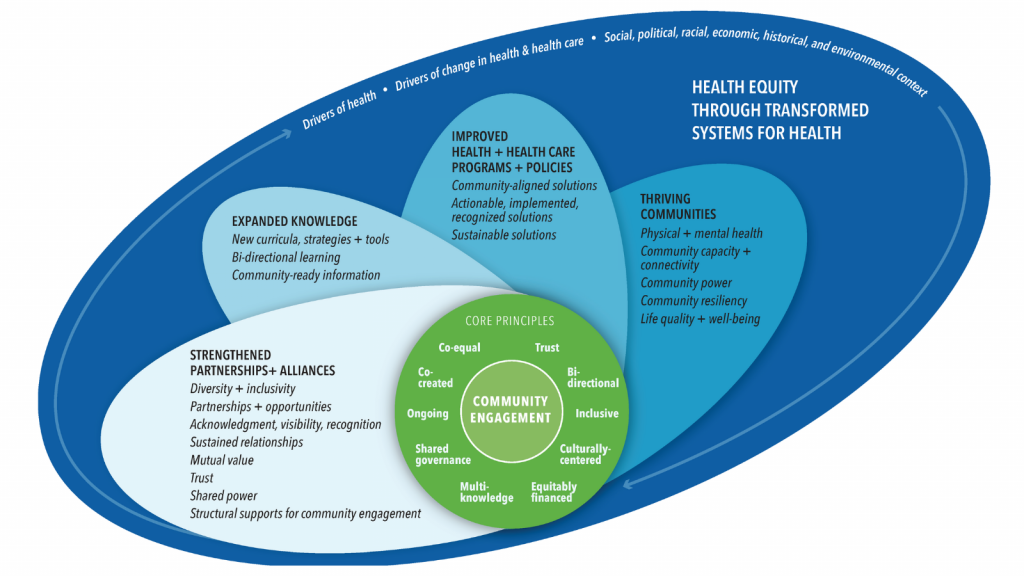
Image description: Community engagement can transform systems and drive equitable well-being outcomes.
Identifying and being clear on your why or what you hope to achieve with family and community connections within Triple P provides:
- a clear vision for moving partnerships forward
- clarity to your outreach
- shared understanding among your coalition for expanding your partnerships
The four family and community engagement outcomes below were identified by experts who collectively identified what’s most important for meaningful partnerships. These outcomes can be flexibly measured and assessed across forms of engagement and across contexts.
Your region might find it helpful to review these engagement outcomes and their components as you explore your region’s goals. This can help inform your strategies for developing partnerships, including your recruitment efforts and even the forms of engagement.
Strengthened Partnerships & Alliances
- Diversity and inclusivity
- Partnerships and opportunities
- Acknowledgement and recognition
- Sustained relationships
- Mutual value
- Trust
- Shared power
- Structural supports for community engagement
Expanded Knowledge
- New curricula, strategies and tools
- Bidirectional learning
- Community-ready information
Improved Outcomes & Services
- Community-aligned solutions
- Actionable, implemented and recognized solutions
- Sustainable solutions
Thriving Communities
- Physical and mental health
- Community capacity and connectivity
- Community power
- Community resiliency
- Life quality and well-being
In Summary
Want to increase positive outcomes for families and youth?
Including family and community perspectives throughout implementation provides valuable insight to increase the use and effectiveness of Triple P services.
Cumberland County Lead Implementation Agency (LIA), On Connecting with Key Leaders

Justin Berrier
Lead Triple P Coordinator
Cumberland County Health Department
Fayetteville, NC
Question: Why is your region interested in expanding your coalition or community leadership team members to include community members and families?
Answer: When someone in our line of work thinks of connecting with key leaders (or stakeholders), typically the people thought of will be those that are in some sort of community or government agency position (Partnership for Children, Smart Start, Department of Social Services, school systems, juvenile justice, etc.). But what if key leaders were not part of these agencies? What would that look like when managing and creating a community leadership team (CLT)? This is something that we are attempting to do within [our region].
To have a strong CLT, there is no question there must be strong community involvement and representation from key leaders within community or governmental organizations that primarily operate some kind of parenting or child focus. Understanding this, there is another somewhat untapped population that should be considered when constructing a CLT – that is, members of community organizations, leaders in the community, and families. The reasoning behind this is twofold: 1) these organizations/families will provide insight that is not muddied by policy and procedure that has been in place for (in some instances) decades, and 2) they may have a more simplistic approach to problem-solving that governmental and larger agencies may not have.
Having a wider range of people to problem-solve with that have varying perspectives at the local level will greatly increase the capacity regarding workforce and the associated development systems, quality and outcome monitoring systems, and media and networking systems. Looking at these three components holistically means that with both the agency and community leader CLT members, more people can be reached for local implementation and scale-up opportunities.
Question: How has your region explored or started bringing in families and community members into your coalition/CLT?
Answer: To date, what we have gained from reaching out to both agency and community leader members is that people want what Triple P has to offer, but they’re confused as to what it is and how to get it started. As the LIA, we have begun to revamp the way that we introduce Triple P to those that may not have an idea of what Triple P is and how the program works with the goal of it being easily attainable to both academics and laypeople.
Question: Any lessons learned, experiences or suggestions for others interested in bringing in more families or community members into your coalition or CLT?
Answer: From our experience, the best way to encourage people to join the CLT (whether agency or community leader) is to open a dialogue and encourage questions. The more people ask questions, the more engaged and the more they will be able to reproduce the answers of what Triple P is and what it has to offer to others that may not have heard of the program. After all, that is the ultimate goal: to have an accessible, appropriate, and sustained program that encourages parents to have positive discipline strategies!
Toolbox Featured Resources
Explore your readiness for expanding family and community partnerships within Triple P implementation.
- Family Engagement in Systems Tool (FESAT, 2020)
- In it Together Video
- Co-creation in the California Foster Care System – Implementation Science at Work podcast
Contributors
Devon Minch and Kimberly Maloney, The Impact Center at Frank Porter Graham Child Development Institute, UNC Chapel Hill
Justin Berrier, Cumberland County Health Department, Fayetteville, NC
Feedback Corner
We welcome your suggestions for future Implementation Science at Work podcasts!
Triple P Support
Triple P Service Delivery Agencies in North Carolina and South Carolina
Connect with your regional Triple P Lead Implementing Agency or county Backbone Organization.
Triple P Lead Implementing Agencies in North Carolina
Contact your implementation support team with The Impact Center at FPG.
Triple P Backbone Organizations in South CarolinaContact your community capacity coach with Children’s Trust.
Have questions about implementing your Triple P program?
Please connect with us and follow the social media links at the bottom of this page.